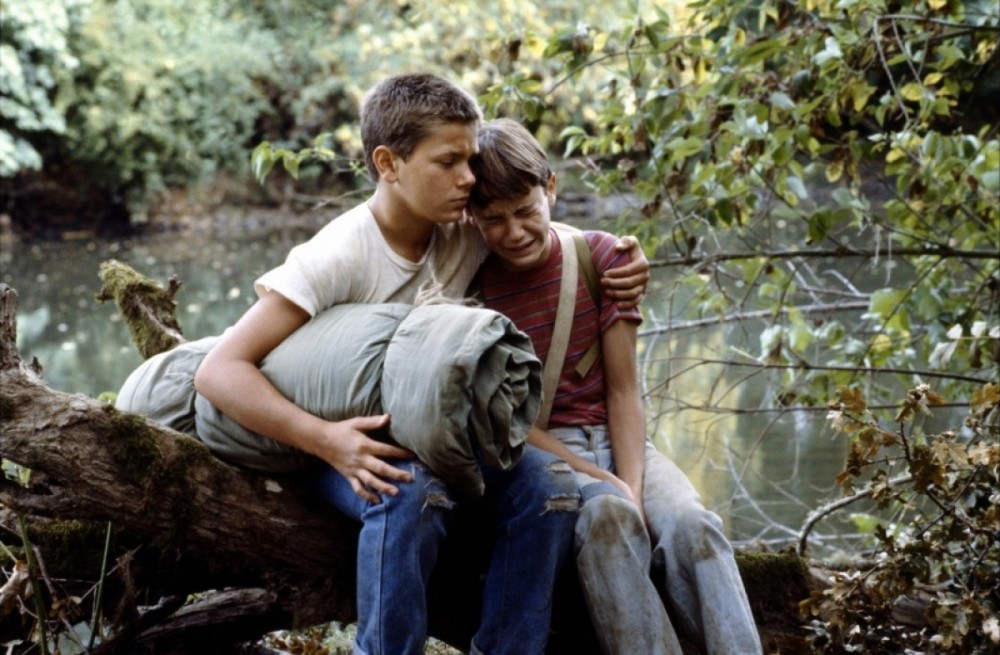
I never liked any movies later on as much as the ones I liked when I was twelve. Jesus, does anyone?
I’m paraphrasing the lines typed by The Writer (Richard Dreyfuss) at the end of Rob Reiner’s Stand By Me, of course, but I think there’s something to be said for the sentiment. I watched the film for the umpteenth time at the weekend, but it was the first occasion that I’d caught it on the big screen, as it’s currently back in cinemas for 40th anniversary screenings. I loved Stand By Me when I first saw it in 1986, or possibly 1987, when I was 12 years old and my family had just taken possession of its first video player, and I feel an equally strong atachment to it four decades later.
It’s a movie that features a heavy dose of nostalgia, set as it is in late-50s rural Oregon, although don’t mistake its take on the period and youthful bonding and adventure as merely a syrupy look back at a simpler, more innocent time. I only have dim memories of Stephen King’s original novella, The Body, but I recall that the nastiness and bullying of certain characters, as well as the mention of various fathers who are either absent or just plain bad, is all just as vivid in the book as it is in the film. I guess when you tack 40 years onto that release date, and can reflect on the differences in watching Stand By Me both as a 12-year-old son and a 50-year-old dad, then its nostalgia takes on an added dimension.
Oddly, the movie does make me yearn for some kind of past, despite the fact I’ve lived nearly all of my like in the UK, have never been to Oregon and missed the 1950s by about 25 years. It makes me feel nostalgic for being twelve years old, and watching this film for the first time, partly because it reminds me of the discoveries I was making at the time. At that age I was getting into films, and just as importantly I was getting into music, hoovering it all up as quickly as possible. Working out what I liked, who I was, how it all seemed to fit together.
Stand By Me‘s jukebox soundtrack of early rock n’ roll and pop hits remains a pleasure today, and is clearly one of the film’s strongest suits. Rockin’ Robin, Yakety Yak, Come Go With Me, Lollipop, Let The Good Times Roll and the like are all familiar to me now, but at 12, when I first watched the film, I was probably hearing some of these tracks for the first time, getting kicks out of the period music. Such great tunes, such fun harmonies and some of them featuring crazy vocal ticks; I still love that early rock n’ roll now, as well as doo-wop and girl group hits of the era. Reiner’s film harnesses the energy of these songs, linking them to the experiences of the 12-year-old friends as well as the gang run by “cheap dime store hood” Ace, played by a young Kiefer Sutherland. Some of these songs are irreverent, and the late director seemed very aware of that irreverence, as well as their keen sense of fun. What a blast they are – I just wish I could hear them for the first time again.
 Lonesome Tonight